• Link to LinkedIn
  • (847) 952-9362
  • CONTACT
Bancroft
  • Architecture
    • Master Planning
    • Drafting
    • BIM/Revit
  • Engineering
    • Mechanical
    • Plumbing
    • Structural
    • Electrical
  • Industries
    • Pharmaceutical
    • Government
    • Healthcare
    • Manufacturing
    • Higher Education
  • Case Studies
  • About
    • Leadership Team
    • Areas We Serve
    • Careers
    • Blog
  • Menu Menu

Everything You Need to Know About Building Information Modeling in Architecture

It takes careful collaboration, precision, and creative problem-solving to transform a project concept into a finished and functional building. With building information modeling (BIM), architects and engineers can get invaluable support throughout the project lifecycle in a collaborative digital environment.

How does BIM work, and why is it such a game changer for the design and construction process? Here’s everything you need to know about this revolutionary tool.

The Basics of Building Information Modeling

Building information modeling is a process that creates digital representations of buildings and their components. It helps architects, engineers, and construction teams manage a project from start to finish. The 3D models contain rich data that can be used to analyze, simulate, and visualize a building and how its various systems work together.

BIM provides a simple and intuitive way for team members to work together on a project since the data is stored on a cloud-based platform. A contractor can access digital plans from the job site, while engineers can work on other aspects of the project from the office. As different people make changes to the plans, BIM software adjusts in real time to keep all information current. The model constantly evolves to provide key data every step of the way, acting as a living representation of the project—even beyond completion.

Elements of Building Information Modeling

BIM is a complex web of data with many different components that help teams work in tandem during a project.

Common Data Environment

A common data environment, or CDE, is the central location where project members can go to access information. An engineer might visit the CDE to adjust beam dimensions in the model, while a facilities manager might use the CDE to access data about HVAC operations and maintenance.

A CDE can reduce project bottlenecks and enable integrated data management across teams. All files, models, specifications, changes, approvals, and issues reside in a single platform to provide a high level of transparency.

Some core functions of a CDE include:

  • Centralized document management
  • Model coordination to ensure up-to-date data
  • Issue management to detect inconsistencies or clashes
  • 2D and 3D model review
  • Version control to track and manage changes
  • Model aggregation

BIM Objects

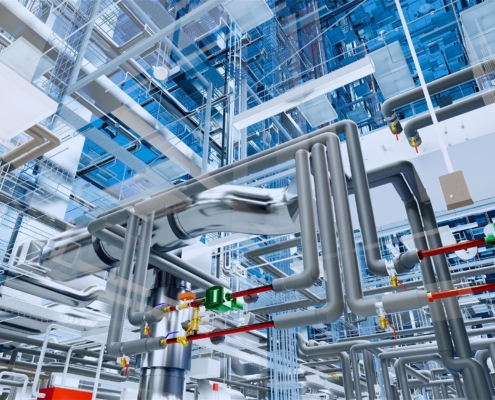
Inside every BIM model are BIM objects, which are digital representations of individual construction elements. Objects store data about their dimensions, materials, related files, connection points, performance, and anything else that may be relevant during design, construction, and ongoing operation. Anything from a duct or pipe to a wall or door can be an object in building information modeling.

BIM objects allow for enhanced analysis and documentation. Because they contain detailed data, a project member could use an object to simulate future energy usage, generate a list of needed materials, or create shop drawings to assist during production or installation.  

These smart objects allow for better analysis and documentation. For example, one can rapidly generate material takeoffs, simulate energy usage, and create shop drawings by combining various BIM objects.

Online BIM object libraries allow team members to select existing items from manufacturers and incorporate them into models. Teams can also create custom BIM objects or alter existing objects to meet their specifications.

Dimensions

BIM dimensions describe the amount of data contained in a model, from scheduling information to cost. A 7D model may contain 2D and 3D images, project timelines, detailed budgets, energy analysis and tracking, and maintenance plans for BIM objects. As more data is added, the model enters a higher dimension.

Understanding the Stages of Building Information Modeling

BIM spans the entire lifecycle of a construction project, from initial design to maintenance and operations. Here’s how BIM can play an integral role during different project phases:

Design

In the design stage, architects and engineers use BIM software to create a virtual model of the building. Project members add details about the building’s dimensions, materials, and systems, allowing them to visualize how the building will function and look at completion. Architects can also share the BIM data with the client for approval and changes and collaborate with the construction team to detect potential problems during the building process.  

As the design progresses, the model serves as the central source of information for the project.

Construction

During construction, contractors use the BIM model to plan and coordinate the sequence of work. The model contains precise measurements and materials needed to fabricate building components offsite and install them efficiently onsite.

Key BIM uses in construction include:

  • Digital fabrication: Fabricators can create structural steel and ductwork based on the model.
  • Construction sequencing: The virtual model helps sequence work to ensure each step is completed on time and in order.
  • Quality control: Teams can reference the model to ensure their work meets the specified standards.

BIM improves communication and can reduce errors during the construction process, ultimately saving the client time and money.

Maintenance and Building Operations

Once construction is completed, facilities managers can use the as-built BIM model to streamline maintenance and operations. The model contains detailed warranty information, product details, and maintenance recommendations for the installed equipment and systems.

Ongoing uses of BIM include:

  • Maintenance scheduling: BIM models can store information about systems performance and manufacturer recommendations for maintenance, allowing facilities managers to determine when maintenance is necessary.
  • Space management: During a renovation or reconfiguration, project members can reference the model to make the best use of what’s already there.
  • Energy reduction: BIM can help compare performance between different machines or buildings, allowing facilities managers to find energy-saving opportunities.

The Importance of Building Information Modeling in Architecture

There are several key reasons why BIM is transforming modern architectural practice:

Visibility

BIM provides much greater visibility into design performance and construction processes. Architects can simulate and analyze issues, while contractors can use BIM to improve work planning, coordination, and quality control.

Collaboration

BIM enables earlier and more extensive collaboration between project team members. With all teams contributing to the virtual model, each project stage can move forward cohesively.

Error Reduction

Clash detection and other issue detection capabilities help teams identify and correct problems before construction when changes are easier to make. This proactive problem-solving helps reduce costly mistakes and project delays.

Efficiency

Architects and engineers can automate many repetitive tasks using BIM and focus their time on design quality. Additionally, since changes happen to the CDE in real time, team members don’t have to wait for communication or updated files before moving forward.

Discover the Power of Building Information Modeling With Bancroft

At Bancroft Architects + Engineers, our team has been leveraging the power of BIM using Revit software for years. From day one of your project, we use BIM to facilitate open communication between clients and project teams, reduce costly errors, and provide greater visibility into the project as a whole.

From hospitals and warehouses to university facilities and pharmaceutical environments, our architecture and engineering teams can use BIM and Revit to plan, design, and facilitate construction for a range of projects.

Ready to start planning your project with BIM? Reach out today.

Share This Post

  • Share on Facebook
  • Share on X
  • Share on WhatsApp
  • Share on Pinterest
  • Share on LinkedIn
  • Share on Tumblr
  • Share on Vk
  • Share on Reddit
  • Share by Mail

More Like This

3D model of building pipes and ducts

Everything You Need to Know About Building Information Modeling in Architecture

January 31, 2024
Building information modeling allows architects to conceptualize projects in a digital environment. Learn how it works and why it’s essential.
https://www.bancroft-ae.com/wp-content/uploads/2024/01/3D-model-of-building-pipes-and-ducts.jpg 1250 2000 Abstrakt Marketing /wp-content/uploads/2023/09/BAE_Logo_Signature-2019-no-.png Abstrakt Marketing2024-01-31 13:11:452024-09-10 11:12:53Everything You Need to Know About Building Information Modeling in Architecture

Understanding the Purpose and Application of Building Information Modeling

January 22, 2024
Building information modeling integrates design and construction processes through intelligent 3D modeling to improve efficiency.
https://www.bancroft-ae.com/wp-content/uploads/2024/01/Understanding-the-Purpose-and-Application-of-Building-Information-Modeling.jpg 1250 2000 Abstrakt Marketing /wp-content/uploads/2023/09/BAE_Logo_Signature-2019-no-.png Abstrakt Marketing2024-01-22 16:05:272024-09-10 11:12:53Understanding the Purpose and Application of Building Information Modeling

Exploring the Advantages Between Traditional and BIM Design

January 18, 2024
BIM design revolutionizes buildings through an integrated data model for enhanced collaboration, accuracy, and efficiency across all project phases.
https://www.bancroft-ae.com/wp-content/uploads/2024/01/Exploring-the-Advantages-Between-Traditional-and-BIM-Design.jpg 1250 2000 Abstrakt Marketing /wp-content/uploads/2023/09/BAE_Logo_Signature-2019-no-.png Abstrakt Marketing2024-01-18 08:27:142024-09-10 11:12:54Exploring the Advantages Between Traditional and BIM Design

Categories

  • Architecture
  • BIM/Revit
  • Engineering
  • Healthcare
  • Uncategorized

Contact Us

"*" indicates required fields

Company

About

Leadership Team

Areas We Serve

Careers


Solutions

Architecture

Engineering

Industries

Case Studies

Contact

1471 E Business Center Dr, STE 900,
Mount Prospect, IL 60056

(847) 952-9362

info@bancroft-ae.com

  • Link to LinkedIn
Website by Abstrakt Marketing Group ©
  • Sitemap
  • Privacy Policy
Link to: Understanding the Purpose and Application of Building Information Modeling Link to: Understanding the Purpose and Application of Building Information Modeling Understanding the Purpose and Application of Building Information Modeling Link to: The Different Types of Engineers and What They Do in Construction Link to: The Different Types of Engineers and What They Do in Construction Engineer using calculator to check measurementsThe Different Types of Engineers and What They Do in Construction
Scroll to top Scroll to top Scroll to top

This site uses cookies. By continuing to browse the site, you are agreeing to our use of cookies.

AcceptLearn more

Cookie and Privacy Settings


How we use cookies

We may request cookies to be set on your device. We use cookies to let us know when you visit our websites, how you interact with us, to enrich your user experience, and to customize your relationship with our website.

Click on the different category headings to find out more. You can also change some of your preferences. Note that blocking some types of cookies may impact your experience on our websites and the services we are able to offer.

Essential Website Cookies

These cookies are strictly necessary to provide you with services available through our website and to use some of its features.

Because these cookies are strictly necessary to deliver the website, refusing them will have impact how our site functions. You always can block or delete cookies by changing your browser settings and force blocking all cookies on this website. But this will always prompt you to accept/refuse cookies when revisiting our site.

We fully respect if you want to refuse cookies but to avoid asking you again and again kindly allow us to store a cookie for that. You are free to opt out any time or opt in for other cookies to get a better experience. If you refuse cookies we will remove all set cookies in our domain.

We provide you with a list of stored cookies on your computer in our domain so you can check what we stored. Due to security reasons we are not able to show or modify cookies from other domains. You can check these in your browser security settings.

Other external services

We also use different external services like Google Webfonts, Google Maps, and external Video providers. Since these providers may collect personal data like your IP address we allow you to block them here. Please be aware that this might heavily reduce the functionality and appearance of our site. Changes will take effect once you reload the page.

Google Webfont Settings:

Google Map Settings:

Google reCaptcha Settings:

Vimeo and Youtube video embeds:

Accept settingsHide notification only